

Patrick Gilbert PT, DPT, ATC, CSCS
Feet tend to get a bad rap in modern society. They aren’t seen as “sexy” and they don’t always smell great. But we use our feet every day of our lives, with every step we take. So why do we pretend our feet and toes don’t need mobility, control and strength like the rest of our body?
Natural Foot Function and Alignment
Our feet have adapted over hundreds of thousands of years to allow us to walk upright on two legs. Not only do we walk on two legs, but we can run, sometimes great distances on these two legs; something almost no other creature on our planet can do.
Our feet (along with the rest of our body) are an engineering marvel. They are incredibly complex structures with 26 bones, 29 muscles, 33 joints and over 200,000 nerve endings in each foot. But that does not mean they are weak or fragile, as many people have come to view them. To quote my friends at The Foot Collective, our feet are designed to be strong and stable, mobile and adaptable, sensitive and resilient.
Our feet are designed to be strong and stable, mobile and adaptable, sensitive and resilient.
Tweet
Each one of us starts life with feet that can do all the things nature intended. Newborn babies can spread their toes apart, move them independently from one another and dorsiflex their ankle to absurd angles. I recently welcomed my second child into the World and found myself mesmerized by the mobility and dexterity my newborn was showing off, just minutes old.
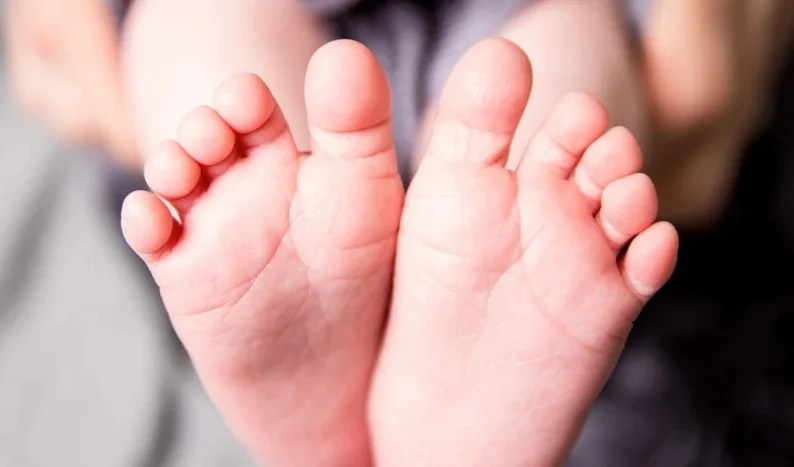
We begin life with the widest part of our foot being our toes. Our toes should be a direct extension of our five metatarsals, splaying outward, rather than pointing towards each other.
So if we have these types of mobile, anatomically correct feet when we are born, why do so many of us have deformed, painful feet as we age? One major reason is the shoes we wear on our feet.

Humans and Footwear
For most of our existence as bi-pedal walkers, humans were either barefoot, or wore thin pieces of leather bound to the bottom of our feet. This primitive footwear had one purpose: to protect our feet from our environment. Overly hot and cold things. Sharp stuff! Our ancestors didn’t need “supportive, cushioned foam”, “motion control technology”, or whatever those air bubbles in the soles of some shoes do. And here is the secret “modern shoe” companies don’t want you to know: neither do we! So why have we been convinced that we need those things? We’ve been told we need external support and cushion because our feet “can’t handle it”. Because the modern day shoe is considered “fashionable”. Because if enough people have deformed, painful and weak feet, it becomes the norm, and therefore it’s not weird to feel like you need all these things to support your immobile and fragile hooves.
So where is the disconnect? When we refuse to use our feet as intended, stuffing them into restrictive, bulky or straight up wild (looking at you, high heels!) footwear, instead of interacting with our environment properly, we are left with shoe-shaped feet, rather than walking around with larger, more adept versions of what we are born with.
Shoes and Foot Anatomy
Our footwear should complement our anatomy and allow for full expression of normal mobility and strength, not suppress it. Our footwear should be wide, thin and flexible. The Foot Collective preaches the Five F’s of footwear:
- Foot-Shaped
- Flat
- Flexible
- Feel
- Fixed
Let’s look at some key aspects of modern-day shoes and where they get it wrong.
Foot-Shaped
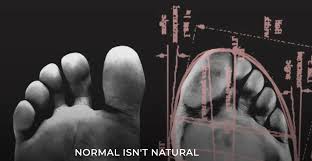
When we look at most modern-day shoes, they tend to be widest at the metatarsal heads (our knuckles), then have a significant taper in the toes. However, as described earlier, the widest part of our feet is our toes, not our knuckles. A narrow toe box does not allow for full toe splay or spread. Being able to properly spread your toes helps to anchor us to the ground with a wide, stable base. Restricting our toes from spreading and functioning properly can cause our toes to narrow and scrunch over time, leading to poor function, decreased balance and pain.
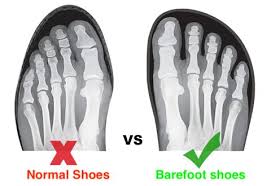
Try this with a pair of shoes you wear often: take the sock liner (or insole, as some call it) out of the shoe and put it on the floor. Place your foot on top of it and see how much overlap your foot has with the sock liner. Now imagine your foot on that same sock liner, but inside a shoe that will keep your foot conformed to the shape of the shoe, kind of like the picture above. This is how “shoe-shaped feet” are created.
Flat
Another extremely important aspect of footwear is to have a flat shoe. This means the heel and forefoot are on the same level. Most modern shoes have a higher heel stack, or more cushion under the heel than the forefoot. This creates a “drop” or mismatched height between the heel and toe, meaning the heel is up higher than the forefoot.
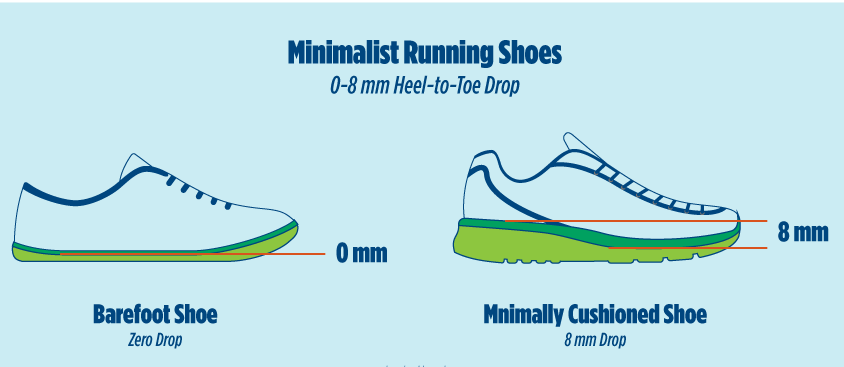
Why is this an issue? When the heel is up higher than the forefoot, you are in some degree of plantarflexion. This shortens the calf musculature and Achilles tendon. Even if slight, this shortening can have a long-term impact on muscle length and tendon extensibility, ultimately impacting strength and resilience.1 This heel stack also limits the amount of dorsiflexion needed during each step. This is similar to squatting with a raised heel. When you lack sufficient dosiflexion, this heel lift gives you the assistance needed to get deeper into a squat without needing to access as much dorsiflexion. Running with a higher heel stack may also decrease running economy and stability.2 When you add this to your shoe you are limiting how much dorsiflexion you need with every step. As is the case with many things, if you don’t use it, you lose it.
Another issue this heel stack creates is abnormal posture. Any amount of resting plantarflexion you are in increases the knee flexion, which increases the hip flexion, and up the chain to increased lumbar lordosis, thoracic kyphosis, cervical lordosis and forward head posture. This occurs all in an attempt to keep the body’s center of gravity over your base (the feet). Think of someone you have seen recently wearing high heels. They don’t stand or walk with normal posture or gait. Although to a lesser degree, this is happening whenever we stand or walk in a shoe with a heel lift.
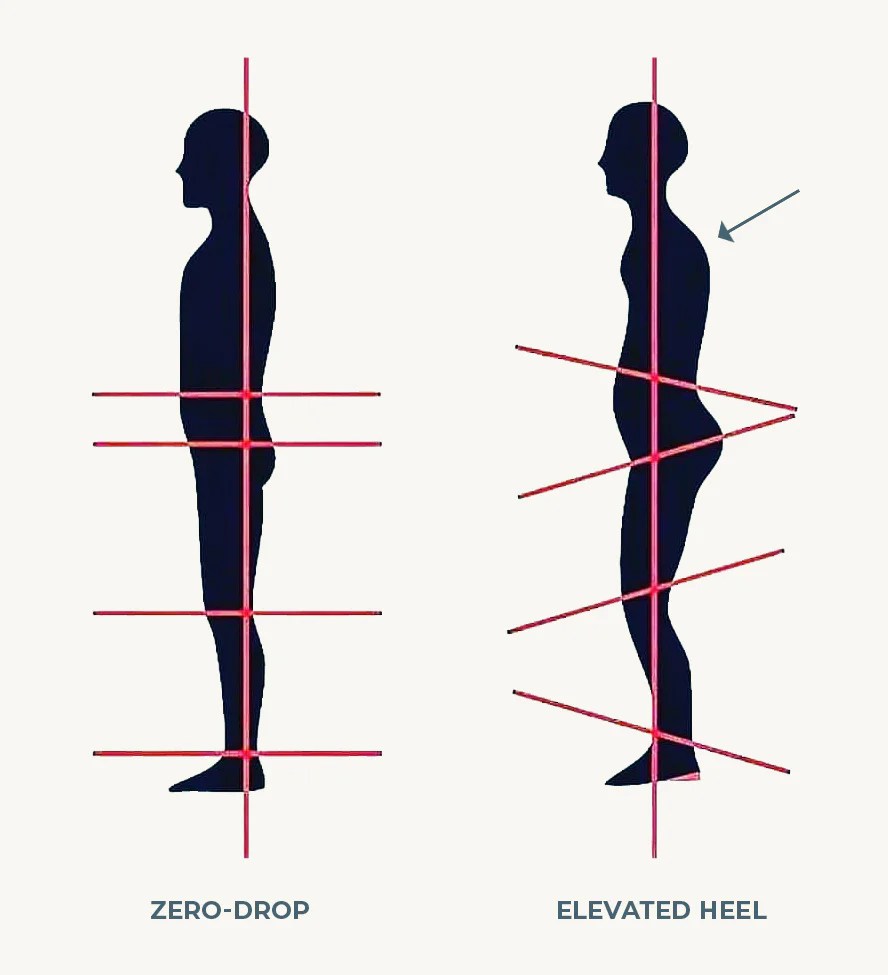
Conversely, wearing a flat, or zero-drop shoe allows us to move with normal posture (assuming we don’t have pre-existing postural abnormalities from years or decades of sitting, but I digress). It also places the calf and Achilles in a more anatomically correct length which allows for normal strength and full access of available ankle motion.
The last piece of the flat footwear equation is toe spring. Toe spring refers to the upward curve of the front of the shoe. This is built into many conventional shoes as a means to “assist” with push-off during walking, further limiting the effort needed to put one foot in front of the other. Elevating and extending the toes also puts the intrinsic (muscles that start and end in the foot) toe flexors in a lengthened position. Over time, this lengthened position creates weakness in these toe flexors, reducing our ability to push off from the toes. This selectively targets intrinsic flexors, which attach to the middle joint of each toe, versus the extrinsic flexors whose tendon attaches to the end of the toes and muscle belly is above the ankle. Weak intrinsic toe flexors can contribute to what are known as “hammer toes”, where the toes are stuck in a rigid, flexed position.
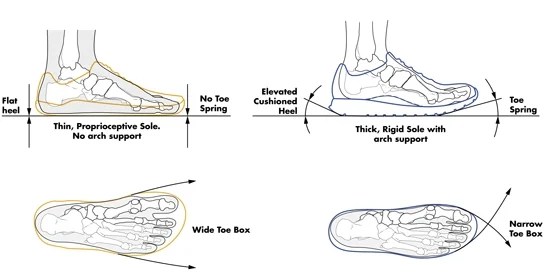
Wearing shoes with a flat toe can help reduce this issue and promote more natural foot function during standing, walking and running.
Flexible
So many of today’s shoes are thick, chunky and rigid. One of the hallmarks of a natural foot is the amount of mobility and flexibility they are built to have. Our feet are designed to adapt and shape to the surface they are standing, walking or running on. When we place this mobile foot into a stiff shoe that only allows a small amount of anatomical movement, over time, we see this change reflected in the foot and we lose the natural ability of our foot to conform to the surface it is in contact with.
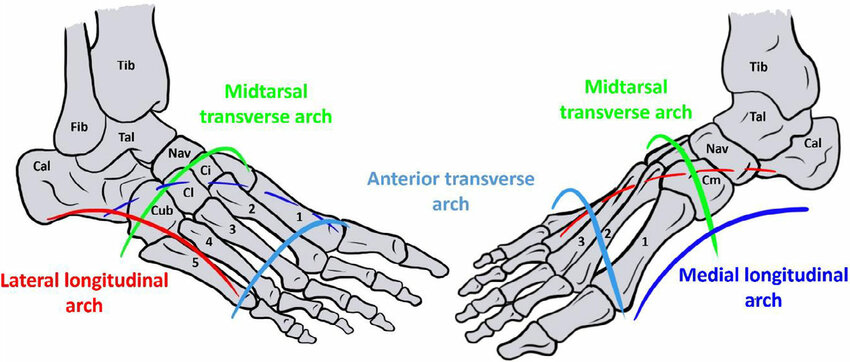
Our feet have multiple arches that give the foot stability and structure. We have longitudinal arches along our medial and lateral foot, as well as transverse arches, both proximally and distally. But these arches are not fixed, allowing the foot to be uniquely mobile. Our feet can flex and extend, pronate and supinate, invert and evert. All due to the unique structure of the bones, ligaments, muscles and arches that create this anatomical wonder.
Our toes are meant to be able to fully flex and extend. When we wear thick, rigid shoes, it does not allow our toes to extend fully. Far too many people have inadequate big toe extension, becuase as stated before, if we don’t use it, we are most likely losing it. We rely on the shoe to support and propel us, rather than the intrinsic strength of our own muscles. So we get weaker and less mobile. It’s a vicious cycle.
So how do we fix this? Wear shoes that have the minimal amount of material so as to allow your foot to move the way it was intended, and was able to as a child. Footwear should allow our feet to express the flexibility that is inherent in their design.
Feel
Our feet have some of the most densely packed nerve endings per square inch than almost anywhere else in the body. They were designed to feel what we are standing or moving on to give us feedback on our environment.
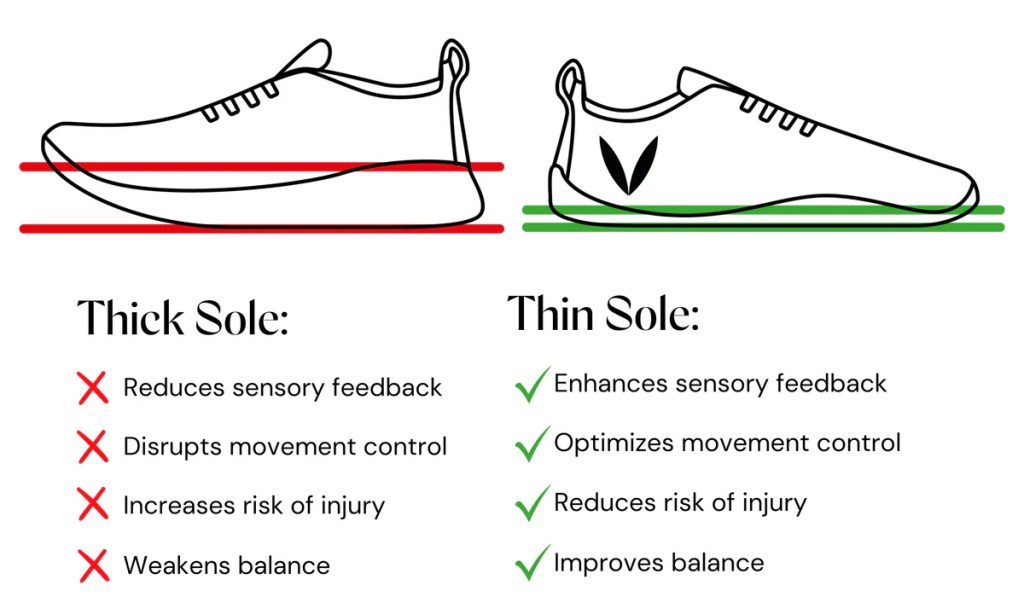
If we walk in padded, cushioned footwear, our feet do not get the sensory input they crave, so our senses become dulled. Then when you do try to walk on something like gravel it feels uncomfortable. If you train your feet to feel the environment around you, these types of things are no longer uncomfortable.
Our footwear should have just enough protection to keep us from getting hurt by what we are walking on, but not so much that it does not allow our feet to feel what is underneath them.
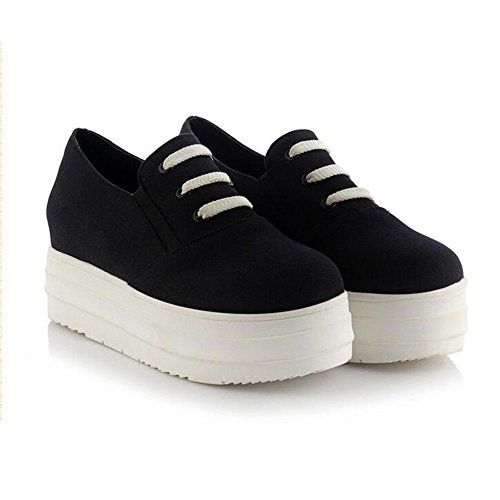
Fixed
This is one factor many people don’t think about. Footwear should be fixed to your foot. This means some sort of strap or lace system that keeps the footwear on your foot without you having to work to keep it there. When you wear something like a slide without a heel strap, you are forced to crunch your toes to grip the sole to keep it in place. Doing this does not allow for adequate toe extension, as referenced earlier. So while you may think wearing slides is comfortable and convenient, they may be doing more harm than good.
Takeaways
In summary, we should opt for footwear that allows our feet to function the way they were designed. Does that mean we may need to rethink our current ideals of fashion? Possibly. Does that mean we need to throw away every single pair of non-natural footwear we possess? No. You don’t have to wear natural shoes 100% of the time. In fact, you should probably ease into them if you are not used to wearing minimal or barefoot shoes.
Yes, you can still wear those shoes you used to think looked good when you were in your “sneakerhead” era before you learned the damage they were doing to your feet with long-term wear. What matters most is what you wear the majority of the time. Wearing conventional shoes while focusing on foot training is like taking two steps forward and one step back.
Natural footwear is not magic. But wearing footwear that allows your feet to display the full magic of our structure and function can only be seen as a net positive.
I’ll leave you with one more picture. Maybe I could have just led with this and saved all the words.
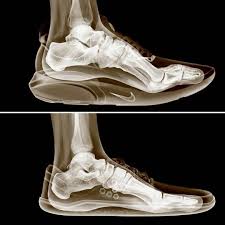
Looking at it from this perspective, would you rather wear the top shoe or the bottom one? Your feet will thank you if your footwear choice allows them to be feet.
References:
- Trappe SW, Trappe TA, Lee GA, Costill DL. Calf muscle strength in humans. International Journal of Sports Medicine. 2001 Apr;22(03):186-91.
- Kettner C, Stetter B, Stein T. The effects of running shoe stack height on running style and stability during level running at different running speeds. Unpublished. 2024 Nov;21.
About the Author – Patrick Gilbert PT, DPT, ATC, CSCS

Patrick is a physical therapist, athletic trainer and personal trainer. He runs Summit Performance and Therapy in Indianapolis, Indiana. He has been training clients of all backgrounds for years and has been a practicing physical therapist since 2016. His training philosophy combines his knowledge of rehabilitation as well as strength and conditioning in order to train clients to achieve great results and avoid injuries in the process. His physical therapy practice focuses on a three-dimensional view and treatment of the body and its many parts. Treatment emphasizes manual techniques and rehabilitative exercises to get patients back to previous activity levels without pain or dysfunction.
For more information about training or rehabilitating with Patrick, contact him at SummitPerformancePT@gmail.com or visit SummitPerformancePT.com
 Summit Performance and Therapy